
Comanche Property Tax Fields
No single public screen holds all Comanche County property tax records. The CIC Appraiser system carries the parcel identity and value fields. So most property search work starts there. The Treasurer keeps tax information and takes payments. But its county page posts no stand-alone bill lookup. The Clerk supports tax administration and routes appeals.
| Field | What It Shows | Where |
|---|---|---|
| Appraised total | Land plus improvements at appraised value | CIC card |
| Assessed value | Tax base after the class ratio | CIC card |
| Taxing unit | Local jurisdiction code tied to the parcel | CIC card |
| Bill and payment | Year-specific amount and status | Treasurer request |
| Appeal record | Value dispute and supporting form | Appraiser, Clerk, or state appeal body |
Kansas generally assesses residential real property at 11.5 percent of appraised value. Other classes carry different ratios. The levy then applies to that assessed base. Neither figure should ever be quoted as a known sale price.
CIC Tax Search Evidence
Indexed CIC cards display a full set of fields: owner's name, mailing address, property address, PID, Quick Ref ID, class, acres, neighborhood, taxing unit, legal description, value history, and assessed figures, plus links labeled View Tax Detail and View Deed Information. Which search fields are truly optional is harder to say. The portal's postback form does not publish that detail. So treat any claim of nightly updates with caution. The card itself remains the reliable record.
| Address | Starting clue for one property |
|---|---|
| PID | Exact parcel key for tax requests |
| Owner label | Tax-roll name, subject to update lag |
| Taxing unit | Jurisdiction clue such as a city code |
| Update stamp | Card-specific freshness evidence |
The county Appraiser page is the official source for the valuation route and its forms.
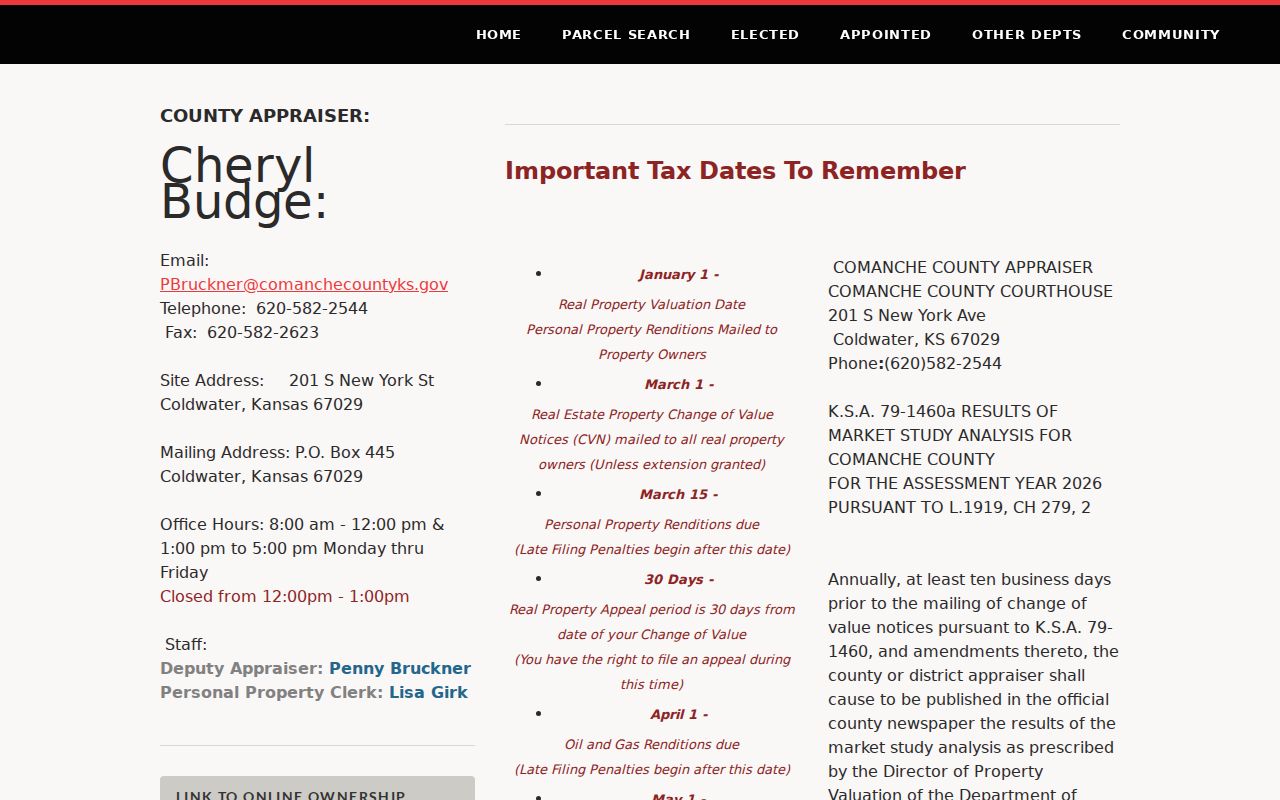
That page helps separate the Appraiser's value work from the Treasurer's bill and payment role. Keep a copy of the card and its timestamp when a notice or bill needs review. Sample cards carried staggered 2026 update dates.
Comanche Tax Value Formula
Appraised value is the Appraiser's estimate for the parcel. Assessed value is the portion that serves as the tax base. The Kansas classification ratio is applied to reach it. A mill levy is simply the tax rate. It is charged per thousand dollars of that assessed value. The final bill can also reflect the taxing units serving the parcel. One Coldwater residence sample showed a 2026 appraised total of 12,950. A Protection vacant-lot sample came in at 2,570. Neither number is an average. Class, land use, improvements, and taxing geography differ so much. Comparing them directly tells you little.
Find a Comanche Tax Bill
The county Treasurer page offers a counter, a phone, and a payment route. It posts no public bill-search link. Start with CIC to pin down the parcel. Try the card's View Tax Detail link. If that route fails, ask the Treasurer at 620-582-2964 for the year-specific account and status. Office hours run 8 to 5, closing from noon to 1.
- Find the CIC parcel card by address and copy its full PID.
- Open View Tax Detail if it works, noting the tax year and account.
- Ask the Treasurer for bill, payment, or delinquency detail by PID and year.
- Confirm any value or class question with the Appraiser, not the payment office.
- Assessed value
- The appraised amount after the class ratio.
- Mill levy
- The rate applied to each thousand of assessed value.
- Homestead relief
- A state-administered form of eligible tax relief, not a presumed card flag.
- Tax lien
- A recorded claim arising from unpaid tax.
Comanche Assessment Calendar
The county's published process values real property as of January 1. Change-of-value notices go by March 1, and the county materials describe a 30-day appeal period. The Appraiser certifies the roll on June 1. State and county materials also identify later payment-under-protest and payment dates, which depend on the chosen path and tax cycle.
Dates serve different acts. An informal valuation appeal after notice is not the same step as paying tax under protest. Read the current notice and form, then confirm the deadline with the office before filing.
Comanche Protest Form Details
The county Appraiser forms page links a payment-under-protest form. A hearing-request form also exists. It asks for plenty: owner or representative, parcel identification, address or legal description, requested value or classification, hearing preference, phone or email, signature, and date. Those demands explain why a parcel-specific evidence file beats a broad complaint. Strong support includes the value notice, the parcel card, photos, and measurements. Class or use facts, comparable evidence, and any correction to the legal description also belong in the file. Keep proof of timely delivery.
2026 Comanche Market Study
The Appraiser reports residential values kept rising slightly through 2025. General 2026 trends run roughly 2 to 8 percent. Vacant land stayed stable, showing no clear overall trend because data were limited. Commercial and industrial results ran mixed. These are broad study findings, not promised changes for any one parcel.
Always check the individual card and notice. A parcel can move differently. Condition, class, improvements, land use, neighborhood, or corrected data can all shift the outcome.
Delinquent Comanche Property Tax
The county publishes no current delinquent-tax list or tax-sale calendar. Request year-specific status from the Treasurer or Clerk by PID. Search the Register of Deeds for any recorded tax instrument. Try the District Court when litigation enters the picture. Newspaper legal notices can still supply a date or party clue for older proceedings. Payment status, a tax lien, and a completed tax conveyance are three different facts. Confirm the later payment, release, redemption, court order, or deed before stating any outcome.
KORA Tax Record Requests
No portal exposes the Comanche County property tax record you need. Send a narrow Kansas Open Records Act request to the office that holds it. Identify the parcel, owner label, tax year, PID, requested record, and preferred format. Ask about fees before staff starts a broad search. Route it right. The Appraiser handles valuation and parcel data. The Treasurer handles bills and payments. The Clerk keeps its tax-administration records. A precise custodian choice shortens the whole route.
Comanche Taxing Unit Clues
A taxing unit tells you which local governments levy on a parcel. Sample CIC cards show labels such as COLDWATER CITY-001 and PROTECTION CITY-002. That label beats a ZIP for placing a property in a municipal context. A postal city can stretch across rural routes. An owner's mailing address may sit in a different city entirely. A taxing-unit label still cannot replace the full tax bill or a legal boundary determination. Record it alongside the PID, the property address, and the legal description. Then ask the Treasurer which levies and tax entities attach to the year-specific account. If city status is disputed, compare the card against ORKA city-limit data. Confirm with the Appraiser or the municipal custodian. Never assume parcels sharing a mailing city share the same levy mix.
Class matters just as much as location. A residential tract, a private vacant lot, and a city-owned vacant lot can carry different ratios. They can also carry different land factors, exemptions, and tax treatment. Check the card's class and use fields before applying any Kansas assessment ratio. Public ownership alone does not tell you a parcel is exempt. Ask the responsible office for the exemption or tax-account record.
Comanche Tax Sale Verification
The county publishes no current delinquent-tax list or sale calendar. That absence is not evidence that no delinquency or sale exists. It simply means you need a year-specific request. Give the Treasurer or Clerk the PID, owner label, property address, legal description, and tax years. Ask separately about amount due, payment status, delinquency, publication, redemption, and any sale result. A newspaper notice can supply a party, a tract, and a date clue. The Kansas Historical Society identifies the Western Star as a long-running Coldwater newspaper. Surviving issues go back to 1884. Historic notices may explain a tax or estate event when the current parcel card is silent. Treat them as leads, not proof. Connect any tax-sale notice to the later payment, redemption, court order, or recorded tax deed.
Search the Register of Deeds when a tax lien, release, sheriff's deed, or tax deed may have been recorded. Search District Court only where litigation enters the trail. Each office answers one stage of the process. Keep dates and document numbers separate rather than collapsing them into a single tax status.
Keep Comanche Tax Years Separate
Tax questions should always name the year. A current CIC value, a prior-year bill, a payment-under-protest filing, and a delinquency record can each reflect different dates. They can show different stages of the same parcel. Save the value notice, the parcel card timestamp, bill detail, receipts, and office responses as separate items. If the parcel changed through a split or combination, ask which PID carried each year's tax account. Keeping the years straight prevents you from applying a later value to an earlier parcel record. It also prevents a mismatched payment status. The file you build should show the timeline, not just the answer.
Contest a Comanche Assessment
Start with the change-of-value notice. Compare it against CIC. Then contact the Appraiser promptly about errors or the appeal route. Under the county's published 2026 information, the notice-stage period runs 30 days from mailing. State Board of Tax Appeals material covers the later state route when one applies. A bill or payment protest follows its own timing and forms. For value terms without the bill process, see Comanche County property value records.
Appeal window. The county says the 2026 change-of-value notice carries a 30-day appeal period; verify the date printed on the notice before filing.