
Comanche County Deed Types
The Comanche County Register of Deeds is the custodian for deeds, mortgages, releases, assignments, liens, plats, and other recordable instruments affecting Comanche County land. Each deed record names the parties and describes the land being conveyed. One filing rarely tells the whole story. A later mortgage, release, easement, or court-linked document may bear on the same tract, so read any deed alongside the instruments that followed it.
| Deed Type | What It Does | Common Use |
|---|---|---|
| Warranty deed | Conveys an interest with stated covenants | Conventional transfer |
| Quitclaim deed | Conveys only the interest held | Interest cleanup |
| Executor deed | Conveys through an estate representative | Probate transfer |
| Sheriff's deed | Records a court-directed conveyance | Foreclosure result |
| Tax deed | Records a tax-sale conveyance | Delinquent-tax process |
Keep the categories straight. A deed transfers an interest. A mortgage or lien is an encumbrance, a claim that burdens the land. Ask for the release or satisfaction that cleared the burden, not just the original filing. The county publishes no web field list or online cutoff for record types. Name the documents you want in a focused request.
Comanche Deeds Are Office-First
Comanche County offers no official online deed index, image system, or published coverage date, so deed records here start at the office. Reach the Register of Deeds at 620-582-2152, by mail at PO Box 576, Coldwater, KS 67029, or in person at 201 S New York. The office keeps weekday hours of 8 to 5 and closes from noon to 1. Give staff a narrow date span plus every party name and parcel number you hold. The official Register of Deeds page confirms the counter, phone, and mail routes to the recorder.
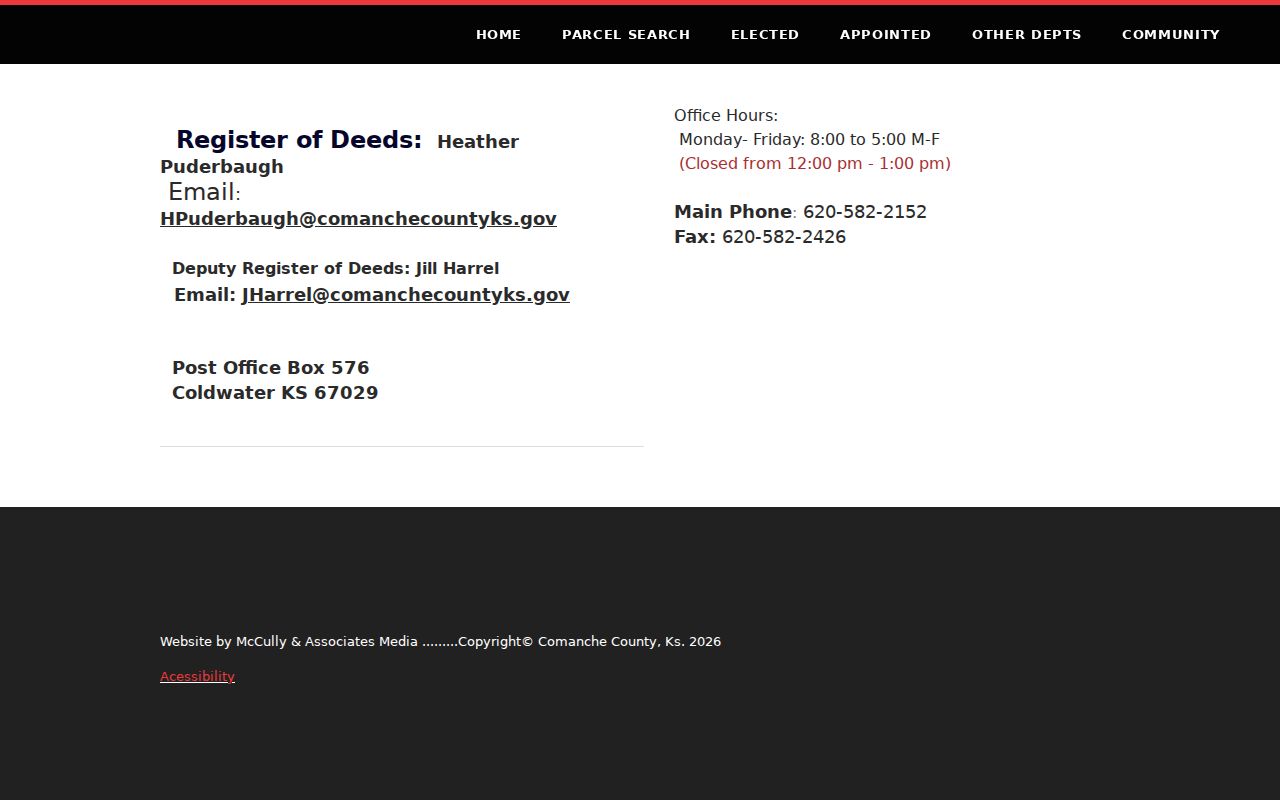
Comanche County publishes no public index link online. Phone, mail, counter visits, and KORA requests carry the load. A Kansas Open Records Act request works when the ordinary counter route falls short. Describe an identifiable record, your preferred format, and a date range. Ask the custodian to quote copy or certification costs in advance. Comanche County publishes no fee schedule.
Online gap. No official Comanche County grantor-grantee portal or cutoff year was found, so older deeds must not be treated as absent.
Parcel Cards Point to Deeds
The CIC assessor parcel card is not itself a deed. Cards typically list a deed document number and a View Deed Information link. Sample numbers 64-715, 64-718, 64-720, 64-726, and 64-717 show how that handoff works. Before contacting the recorder, save the deed number, owner label, PID, and the full legal description. A street address alone is a weaker query. Deed indexes usually turn on party names and legal land text.
One example is 711 E First St. It cites Parker Wright Addition Block 35 plus a vacated-alley clause. Copy every word of it. Truncated legal text can make two parcels look identical or hide land added through a plat or vacation.
Comanche Grantor-Grantee Chain
In any conveyance, the grantor gives the interest and the grantee receives it. A chain of title grows by linking deeds. Each acquiring deed connects to the next conveyance touching the same full legal description. How far the online records reach is unknown. Ask at the counter what years and index formats exist.
- Start with the CIC deed number or newest instrument affecting the full legal description.
- Read the grantor, grantee, date, type, and prior references.
- Search the grantor as an earlier grantee to find that party's acquiring deed.
- Repeat, then ask for bound-book, film, or terminal access when the working index ends.
- Grantor
- The party transferring the stated interest.
- Grantee
- The party receiving that interest.
- Chain of title
- The linked sequence of recorded transfers.
- Book/page
- A volume and page citation.
- Document number
- A unique recording reference.
Comanche Liens and Releases
Request mortgages, assignments, releases, mechanic's liens, tax liens, easements, judgments, and lis pendens under the same parties. Use the same legal description as the deed. A lis pendens warns that litigation affecting the land is pending. Then match each burden to any later release, satisfaction, cancellation, or judgment.
The District Court handles foreclosure and quiet-title cases. A docket entry is not a deed. Tie the outcome back to a sheriff's deed, judgment, or other instrument. The Register of Deeds recorded it.
Kansas Recording Fee Baseline
K.S.A. 28-115 sets the state's recording-fee framework. It does not say what Comanche County charges for plain copies, certification, mailing, or a broad staff search. Request a quote, and separate recording a new instrument from copying an old one. Never borrow another county's fee. Page count, certification, and document type all shift the total.
Older Comanche Deed Books
Older deed books, plats, and indexes sit with the recorder. The county has never stated its earliest book, microfilm run, or digitization cutoff. Ask which volumes are bound or filmed. Ask which are readable at a public terminal. When an addition or block shows up in a legal description, request the plat book. Ask for the page number too.
For historical context, the Kansas Historical Society places Coldwater's Western Star as likely starting August 23, 1884. Its surviving file begins September 20, 1884. Legal notices in those pages can date an estate, tax sale, or road action. They add color. The deed remains the title source.
Write a Comanche Deed Request
Put everything in writing. State grantor and grantee name variants and approximate dates. Include the PID, the full legal description, the deed number, and the instrument types you want. Ask for index entries and images, with their book/page or document references. Say up front if certification is required.
For an estate or court transfer, add the decedent, the executor, and the case number. Or offer a sheriff's deed clue. Otherwise a shift in party names can look like a gap in the chain of title.
Comanche Plat and Deed Links
Plats belong in any Comanche County deed search. A parcel card may describe land by addition, original town, out-lot, block, or partial lot. K.S.A. 19-1207 backs the plat-book and index route at the county level. ORKA adds subdivision, lot, and block layers as map aids. The recorder page publishes no online plat image for a named Comanche plat. The public map inventory offers none either. So quote the legal description exactly. Then ask the Register of Deeds for the plat name, book and page. Request the proprietor, filing date, and any later vacation or replat.
A plat and a deed answer different questions. The plat lays out lots, blocks, streets, alleys, and dedications. A deed records a conveyance of described land. A current tax parcel may combine pieces that began as separate lots. It may also swallow a vacated alley. That is why a Coldwater request should keep the phrase about the north half of a vacated alley intact. Later splits and combinations can also leave a current PID. It may differ from the identifier in an older chain of property records.
Ask the recorder to note every cross-reference printed on the instrument or plat. Compare those references against the current CIC description and the ORKA GIS map. A mismatch does not prove an error. It may signal a replat, street vacation, corrective deed, or parcel change. Any of these points to another recorded document in the deed records.
Comanche Estate Deed Breaks
A clean chain does not always run from one ordinary seller to one ordinary buyer. Death, probate, foreclosure, and court action can scramble the party labels or add a step. For an estate, look for an executor or administrator deed, beneficiary deed, transfer-on-death instrument, affidavit, or survivorship document. The District Court file may explain who had authority. Still, the recorded conveyance is the handoff that matters in the land records.
Foreclosure work may require the court case, a recorded lis pendens, the judgment, and a later sheriff's deed. Tax delinquency can pull in Treasurer or Clerk records, legal notices, redemption facts, and a recorded tax instrument. Never jump from a notice to the conclusion that title changed. Request the final deed or release and match it to the full legal description.
When party names break, give the recorder every role and spelling found in the source property records. A decedent, estate, executor, administrator, trustee, plaintiff, defendant, or sheriff may all apply. Search each role as both grantor and grantee within a tight time span. This preserves the chain without mistaking a probate or court event for the deed itself.
Check Comanche Deed References
Before closing out a Comanche County deed search, compare the instrument's recording reference with the CIC card. Check every later document it cites as well. Names may differ because of initials, marital wording, a trust, an estate, or an entity. Land text can shift after a correction, vacation, split, or replat. Preserve the variation. Then ask whether the recorder index holds cross-references under another party or legal description.
Verify that any release points back to the same mortgage, lien, or assignment. A similar name is not enough. Match the original reference, the parties, the dates, and the full land description. Where no online image or deeper index is published, request the index entry along with the copy. That keeps the search path through the deed records clear.
Order a Comanche Deed Copy
Request a Comanche County deed copy by document number or book and page. Confirm the parties and full legal description before paying. The counter, a phone-assisted request, mail, and a focused KORA request are the available channels. The county publishes no self-service image portal or local copy schedule. So ask about electronic delivery, certification, and postage when you order. A plain copy supports research. A certified copy bears the custodian's certification. For the broader route, see the Comanche County property search.
Recorded, not guaranteed. Comanche County deed records show filed instruments; they are not a title opinion and cannot rule out an unrecorded interest.