
Identify a Comanche County Owner
The surest path runs from address to parcel card to deed. The public CIC card displays a field marked Owner's Name. That entry names the tax-roll owner of record for Comanche County. It does not tell you who occupies the land. But it is no substitute for a title check.
- Continue as a public user in the Comanche County CIC portal and search the situs address.
- Copy the owner's name, full PID, legal description, mailing address, and deed document reference.
- Ask the Register of Deeds for the latest instrument that affects the complete legal description. Compare its grantee with the card.
- If an entity appears, verify its exact legal name in the Kansas business search. A resident agent is a contact, not proof of land ownership.
You can also begin with a name. Try punctuation, initials, spouse entries, and exact entity variants. Then use the PID and the legal description to rule out same-name parcels that are not the same land.
Locate Comanche County Ownership Records
Each official Comanche County source answers a different ownership question. Use the tax roll for orientation. Use the recorder for the transfer itself. Use the map for spatial context around the parcel.
| Source | Owner Info It Gives | Access |
|---|---|---|
| CIC Appraiser card | Owner's Name, mailing and property addresses, PID, legal text, deed number | Public-user path; card gives its update time |
| Register of Deeds | Recorded grantor, grantee, date, instrument, and conveyance terms | Counter, phone, or request; no official online index found |
| ORKA map | Address, road, lot/block, subdivision, and city-limit context | Public ArcGIS Experience |
| Secretary of State | Business name, ID, status, and current resident-agent clues | Official online entity search |
Owners come in many forms. An individual, a married couple, or a trust can hold title in Comanche County. So can an estate, a company, or a public body. The cards carry no dedicated trust or estate class. Read the name exactly as written. Let the recorded deed explain how title is actually held.
Read the Comanche County Owner Field
On CIC cards, owner names appear in uppercase and usually surname first. One Sierra card ties its owner to 711 E First Street, a Coldwater mailing address, and PID 017-083-07-0-40-16-003.00-0. The same card also lists Parker Wright Addition legal text and document 64-715. Together, those companion fields turn a bare name into a solid parcel match.
The same card also reports class, neighborhood, taxing unit, acres, values, and building traits. It carries an update timestamp too. No sale date or sale price appears on it. Appraised value cannot fill that gap.
Other parcels test the method. A Coldwater situs at 302 E Maple Street carries a Protection mailing address. A vacant Protection lot at 408 W Walnut sits in neighborhood 208-Protection West. Those records show why owner name and mailing city fail as standalone evidence. The situs must point to one parcel. So must the taxing unit, legal description, and PID. Only then call the name a match.
Search results may shorten names or join spouses with punctuation. Copy the displayed form first. If the owner-name search comes up empty, try surname-first order. Try initials, conjunction variants, and the exact entity spelling. Never merge two people just because their names look alike.
Separate Owner Mail from Situs
Mailing Address and Property Address are separate fields on the card. One verified Comanche County card lists a Protection mailing address for land at 302 E Maple Street in Coldwater. That entry does not move the parcel or prove where the owner lives. It only tells the county where tax-roll mail goes.
- Owner of record
- The party named on the current assessment roll.
- Grantee
- The party receiving an interest through a deed.
- Situs
- The physical place of the parcel.
- Mailing address
- The destination for notices, which may be elsewhere.
- Title
- The legal rights in land, which an owner lookup cannot guarantee.
Check a Fresh Comanche County Sale
Sample cards carry several 2026 update dates. That signals active roll upkeep. It does not fix a deed-to-card schedule. A closing can be recorded before the Appraiser updates its owner field.
Save the card timestamp and document number. Ask the Comanche County Register of Deeds for that instrument. Also request any newer instrument affecting the same legal description. Treat a mismatch as a timing or title question, not proof that either office erred.
Note: The county publishes no average closing-to-roll lag or guaranteed daily synchronization schedule.
The county offers no public recorder index. The card's deed reference is the clean handoff. Verified parcel records show document numbers such as 64-715 and 64-726. Give that number to the recorder. Also request the newest instrument touching the full legal description. A later filing may exist beyond the card's cited document. Ask for grantee, grantor, recording date, and instrument type. Also request any prior or release reference bearing on the current ownership question.
Trace a Comanche County Entity
A company may own the parcel. Run the exact label through the Kansas Business Entity Search. It accepts a business name, a Kansas Business ID, or a resident agent name. The result can corroborate the entity and a service contact. It is still not a deed.
Trusts and estates call for a different check. Request the instrument naming the trustee, executor, administrator, or beneficiary. A District Court probate file may explain who holds authority. The recorder shows the land transfer itself.
One verified non-individual example is the City of Protection parcel at 304 N Lincoln Avenue. Its card names the city as owner. The label ties to a Protection original-town description, a PID, and document 64-726. That is why the exact public or entity name should travel into your recorder request. The example does not justify inventing an LLC, trust, or estate. The official Comanche County card shows none.
Contact Comanche County Custodians
Two offices in Coldwater hold the records you need. The Appraiser sits at 201 S New York and answers 620-582-2544; the counter runs 8 to noon and 1 to 5. The Register of Deeds can be reached at 620-582-2152 and likewise closes from noon to 1 on weekdays. Bring the address, the parcel identifier, the owner spelling, and the legal description so staff can pull the right file fast.
A KORA request works best when it names the custodian, the record, the parcel, the years involved, and whether you want to inspect or receive copies. Kansas agencies must respond as soon as possible, and no later than the end of the third business day. They do not have to create a new record just to answer a research question.
The official Sierra parcel card shows the owner-finding fields in one result:
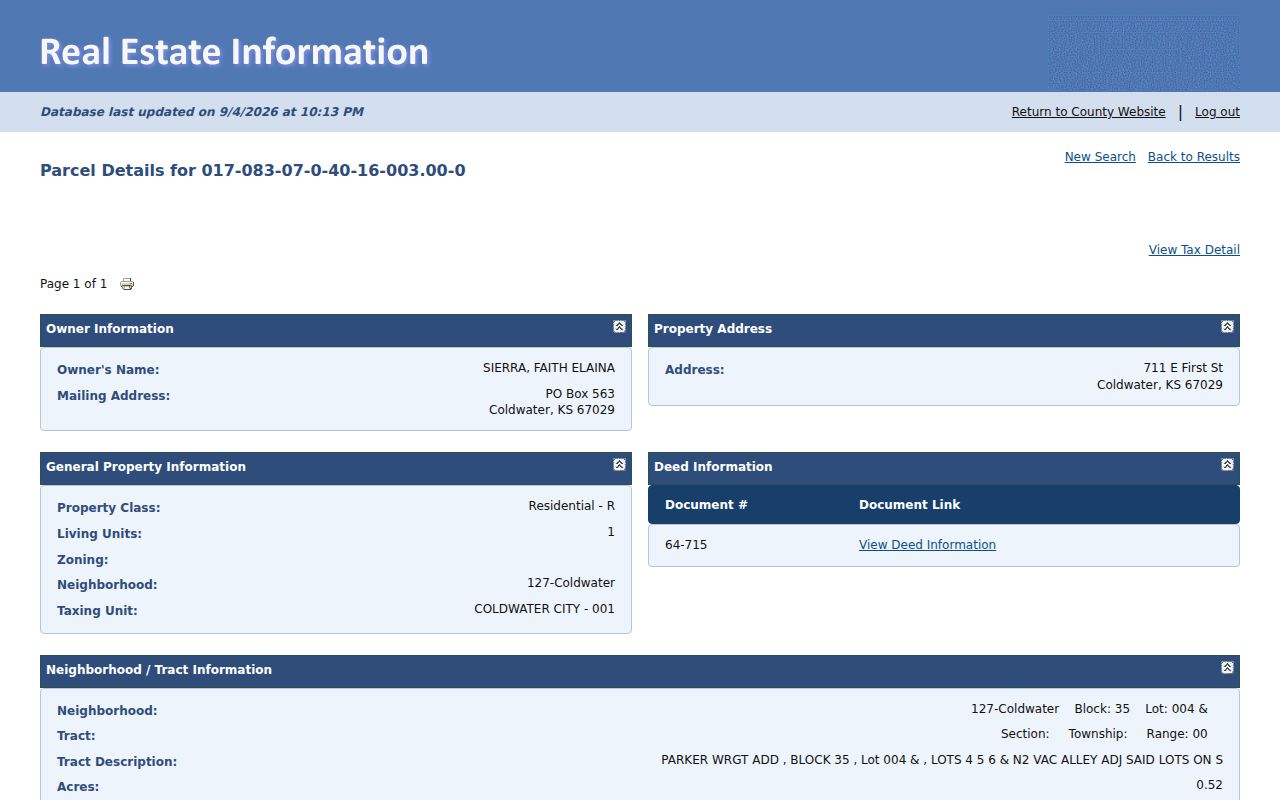
A name alone can mislead in Comanche County property records. Match the owner label together with the mailing address, situs, parcel number, legal description, and deed number instead. That pairing is far more reliable than a single field.
Anyone unable to use the portal can get the same facts by phone. The counter works too. The Appraiser's office sits at 201 S New York, PO Box 445, Coldwater. Its hours are 8 to noon and 1 to 5. Ask staff to read back the owner label and the parcel number. The Register of Deeds is at the same street address, PO Box 576. Its weekday hours are 8 to 5 with a noon closure. Before ordering, say whether you want inspection, an ordinary copy, or a certified copy. Confirm any charge too, since the county publishes no copy fee schedule online.
If taxes are the real question, take the parcel number to the Treasurer at 620-582-2964. The office's public page covers tax information and partial-payment guidance. It offers no online account search. Say plainly what you need: a balance, a receipt, delinquency, payment under protest, or tax-sale history. A specific request keeps the inquiry from sprawling into a vague demand for every county record.
Limits of a Property Owner Lookup
Knowing who owns a Comanche County property is not the same as holding a title opinion. A lookup is only a starting point. The tax roll can lag behind a recent transfer. A deed may vest title in an entity or a trustee rather than an individual. Kansas Safe at Home also lets a protected person substitute a mailing address. Public mail data never proves who actually occupies the parcel.
Lawful use. Use property owner records for due diligence, estate work, or civic research. Never use them to stalk, harass, or harm anyone.
A lookup has clear edges. For a focused check on the present owner of record, one tool stands out. The Comanche County current owner process is the better fit. Older transfers are a different task. Tracing a historical chain of title takes separate deed records work. It moves one instrument at a time.
Boundary questions deserve the same restraint. ORKA can place lots, blocks, roads, and city limits, yet its lines are reference only. The map cannot turn an owner label into proof of title. It also cannot locate a legal boundary. When a line is disputed, the recorded plat and the deed matter most. A licensed survey is the proper source as well.
If no online result appears, use the documented access channels instead. Call the Appraiser, visit the courthouse, or file a focused KORA request. For older context, the Coldwater-Wilmore Regional Library holds notices and local history. The Kansas Historical Society newspaper collection does too. Those materials can surface a lead. Still, only the recorded instrument can confirm a transfer.