
Search Coldwater Property Records
Coldwater property records split across two governments. Comanche County keeps the assessment, deed, tax, and parcel material. The city keeps permits, code files, and moving records. Begin with the physical address.
- Continue as a public user in CIC and search the Coldwater situs address or owner name.
- Copy the full PID, legal description, taxing unit, owner label, deed number, and card update time.
- Use ORKA to compare roads, address points, city limits, subdivisions, lots, and blocks.
- Ask the Register of Deeds for the named instrument and the plat behind the addition and block.
- Check Coldwater's BS&A permit service, then ask the city clerk when the online result is unclear.
Full portal mechanics appear in the Comanche County property search. For Coldwater, the one extra step is the separate city permit check.
Keepers of Coldwater Property Records
The courthouse serves as the county counter for deeds, parcels, and taxes. Coldwater runs its own municipal counter apart from it. The split matters here. The County Clerk states plainly that no county zoning exists, while the city code governs local building and moving permits.
Comanche County records
Appraiser, Register of Deeds, Treasurer, and Clerk functions are at 201 S New York in Coldwater. Noon closures vary by office.
Check Coldwater Permit Records
The official city site hands off permit duties to BS&A services. The portal needs JavaScript, so coverage years, fees, and result formats should be confirmed with the city rather than assumed. The service listings still show the correct municipal office to contact.
| Visible Service | Use | Verified Limit |
|---|---|---|
| Apply for a Permit | Start a city building request | Exact fields not captured |
| Building Department Record Search | Look for city permit material | Coverage years not published |
| Pay a Building Department Fee | City payment route | Amounts not captured |
| Rental Property Search | Vendor's city service label | Not a title or owner source |
A blank online result never proves a permit is missing. Give the clerk the situs, PID, permit type, and date range, then ask whether older files exist only on paper.
Find Coldwater Moving Permits
Coldwater's 2019 code opens an unusual research door for old houses. A building-moving application must state the date and hour. It also lists the planned route. Any utility interference goes in the file as well. A public officer then inspects the structure. For a house that may have changed sites, request the application and route review. Ask for the inspection record too. Request the final disposition as well.
Pair that city file with the assessor's year-built figure and building description. Treat the tax card as data rather than an inspection report. The recorder's legal description anchors the land record. The city file may explain how the building got there.
Coldwater Additions in Property Records
Current Coldwater cards verify two named additions. Recorder book and page references and build eras are absent from the online cards, so only card-supported details belong in the table. Assessor neighborhood codes are internal grouping fields, not subdivision or association names.
| Neighborhood / Subdivision | Era | In the Records |
|---|---|---|
| Parker Wright Addition | Not published | Block 35; lots 4, 5, 6 and north half of a vacated alley |
| Bale & Wileys Addition | Not published | Block 03; Lot 2 and west 25 feet of Lot 3 |
| Neighborhood 127-Coldwater | Current roll | Assessment grouping on the Parker Wright sample, not a plat name |
| Neighborhood 123-Coldwater | Current roll | Assessment grouping on the Bale & Wileys sample, not a plat name |
Quote the complete addition, block, lot, and vacated-alley wording in any recorder request. The Comanche County parcel maps add spatial context, but a recorded plat or survey controls any legal boundary question.
Compare Coldwater Parcel Cards
The Sierra card at 711 E First Street shows a residential parcel in Parker Wright Addition. The neighborhood is 127-Coldwater, and the taxing unit is COLDWATER CITY-001. The parcel covers 0.52 acres. Its deed document is 64-715. The legal text includes a vacated-alley share. The house record lists a 1941 bungalow of 1,008 square feet.
The Willems card at 302 E Maple Street teaches a different lesson. Its Coldwater situs and taxing unit sit beside a Protection PO Box mailing address. The record describes a 1936 bungalow, 1,376 square feet, in Bale & Wileys Addition. A mailing city in Protection never routes a permit request there instead.
See Coldwater Property Records
The Sierra CIC record shows the county fields used in a Coldwater search:
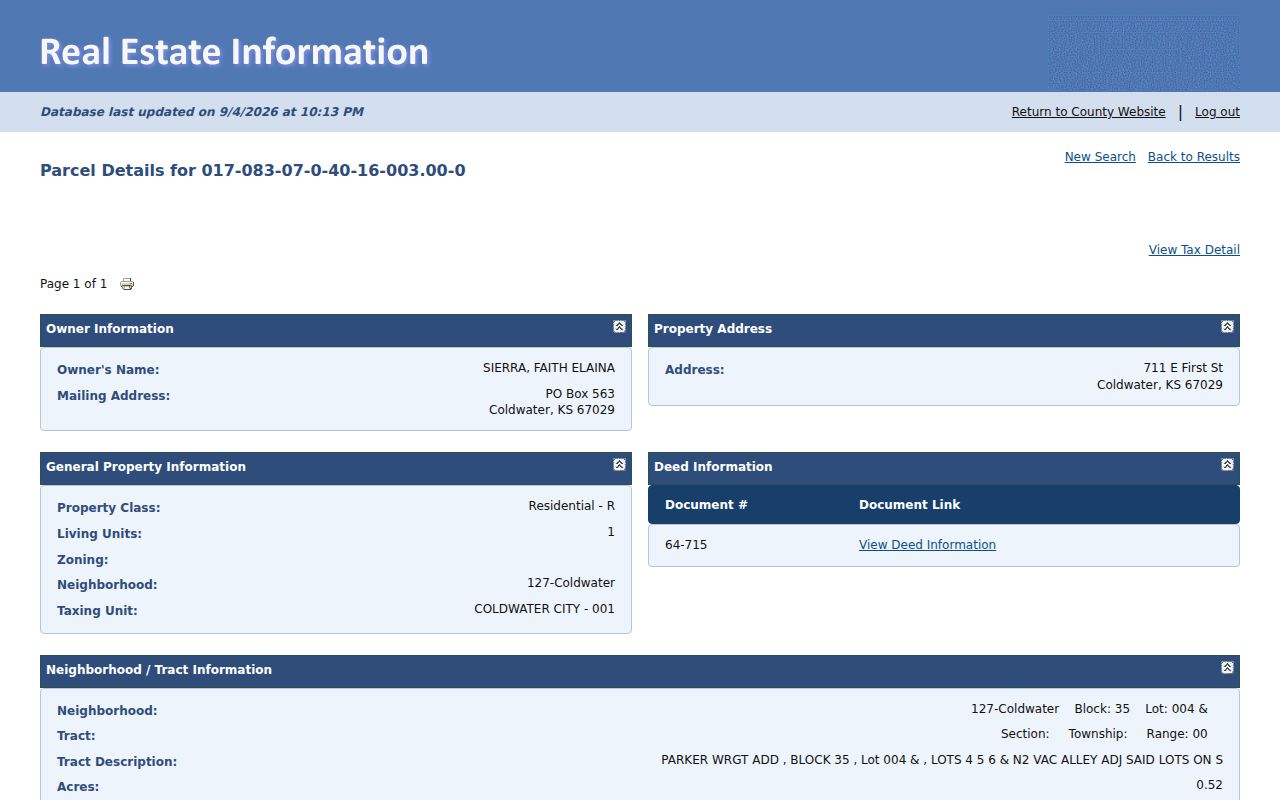
The card joins owner, mailing and situs addresses, PID, legal text, values, and deed number in a single tax-roll snapshot.
The Coldwater departments page provides the municipal permit handoff:
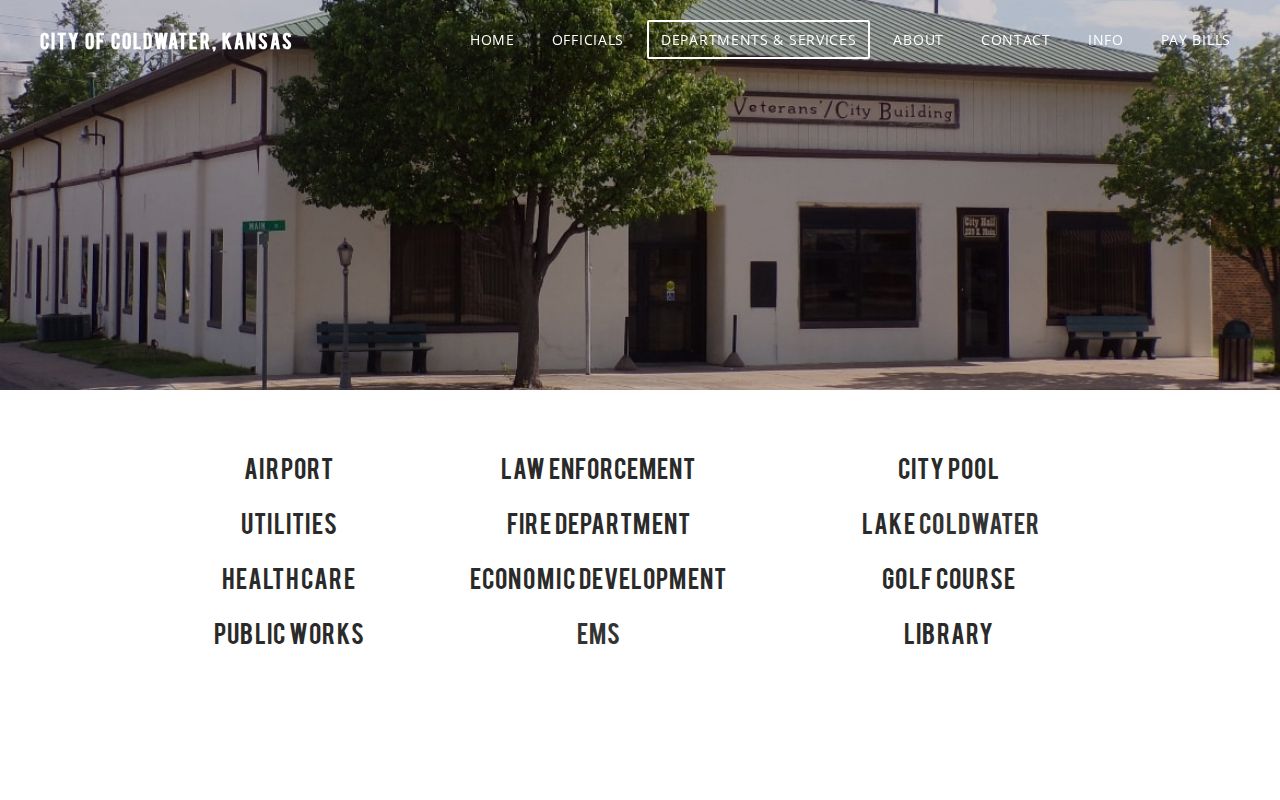
County offices hold the assessment rolls, deed records, and tax accounts. City hall is the place to check for permits and code issues.
Preserve Coldwater Parcel Numbers
Two Coldwater parcel numbers appear in the county data: 017-083-07-0-40-16-003.00-0 and 017-083-07-0-20-10-005.00-0. Copy each string exactly. Keep every zero, dash, decimal, and suffix. The county publishes no legend explaining each segment. For any deed, tax, or map request that leaves the portal, pair the parcel number with the full legal description rather than decoding the format.
Test Coldwater Address Geography
Coldwater situs records use ZIP 67029 and taxing unit COLDWATER CITY-001. ZIP is only a postal clue. Compare the card's situs and taxing unit with ORKA roads and city limits, especially near an edge or when mail routes to another city. No annexation series, incorporation date, or street-renumbering map is published. Old addresses can differ from current ones. Ask the city clerk and the recorder for the ordinance, a plat vacation, the annexation document, or updated legal text.
Read Coldwater Value History
One Coldwater parcel, Sierra, shows a clear pattern. It shows appraised totals of 11,770 in 2023, 12,770 in 2024, 13,030 in 2025, and 12,950 in 2026. That is one parcel's history. It is not a Coldwater appreciation rate. The county's 2026 market study puts general residential growth near 2 to 8 percent during 2025. Individual parcels may differ. Kansas sets an 11.5 percent residential assessment ratio. Appraised total, assessed amount, and final tax bill are distinct figures. Physical changes, corrected data, or comparable sales can each move a card. Ask the Treasurer for the actual account and levy detail.
Trace Coldwater House History
Local newspapers are a good starting point for house history in Coldwater. The Western Star is the key title. KSHS notes it likely began August 23, 1884, with surviving issues starting September 20, 1884. Tie your search to a concrete event tied to the property. A deed transfer or probate filing can anchor a date range. A tax sale, road change, ordinance, or moving permit can work too. A newspaper item may point to a transfer. Confirm it against the recorded deed in the county's deed records. Do not trust the paper alone.
The Coldwater-Wilmore Regional Library at 221 E Main can help fill gaps. Its posted hours run 1 to 8 on Monday and Thursday. Hours are 10 to noon and 1 to 6 on Tuesday, Wednesday, and Friday. The library does not publish a list of its directory, obituary, or microfilm holdings. Ask staff what runs exist before planning a visit around them.
Limits of Coldwater Property Records
Coldwater property records answer many questions well. They name the owner of record, list assessed traits and values, and show recorded transfers. Permit activity and mapped context sit in there too. What they cannot do is prove who actually lives at a parcel. They cannot guarantee what it would sell for. They cannot settle a title question. A line on a GIS map is a general reference, never a survey.
Lawful use. Use Coldwater property records for due diligence, boundaries, history, estate work, and civic research. Never use owner data to stalk, harass, or harm anyone.
When an online index is missing, pick up the phone or make the trip. A written KORA request works too. State agencies must respond as soon as possible. They cannot take longer than the end of the third business day. The first reply may simply say when the records can be produced.