
The Comanche County Owner Record
The CIC Appraiser portal is the county's tax-roll home. Each public card uses exact labels: Owner's Name, Mailing Address, Property Address, PID, legal description, taxing unit, values, deed information, and a last-updated notice. The labels leave little guesswork.
| Owner's Name | The party indexed on the current assessment roll |
|---|---|
| Mailing Address | The destination for notices, not proof of residence |
| Property Address | The parcel's situs or physical address |
| PID | The complete parcel key used across county records |
| Legal Description | The tract, addition, block, and lot wording |
| Deed Information | The document reference for recorder follow-up |
Vesting and tenancy are absent. So are an ownership-since date and any sale price. The owner field is a Comanche County tax-roll label, not proof that the named party lives on the land.
Confirm the Current Comanche County Owner
A fresh sale calls for a two-office check. CIC gives the parcel identity and deed number. The Comanche County Register of Deeds then supplies the recorded conveyance and the grantee who took title.
- Record the exact owner label, PID, legal description, deed number, and card update time.
- Contact the Register of Deeds for that document and any newer instrument affecting the legal description.
- Compare the latest deed's grantee and recording date with the card. Preserve trustee, estate, or entity wording.
- If records differ, ask both offices which source changed most recently.
- Owner of record
- The party named in the current official index.
- Assessment roll
- The Appraiser record used to classify and value land.
- Situs
- The physical parcel address, distinct from mailing address.
- Recording lag
- Time between a deed filing and a later roll update.
Inspect a Current Comanche County Card
A current owner record comes together on a single card. The Sierra example ties an uppercase owner label to 711 E First Street, PID 017-083-07-0-40-16-003.00-0, Parker Wright Addition legal text, the Coldwater taxing unit, and deed document 64-715. The card also carries an update stamp of September 2, 2026 at 6 a.m.
See these fields side by side on the official CIC parcel card:
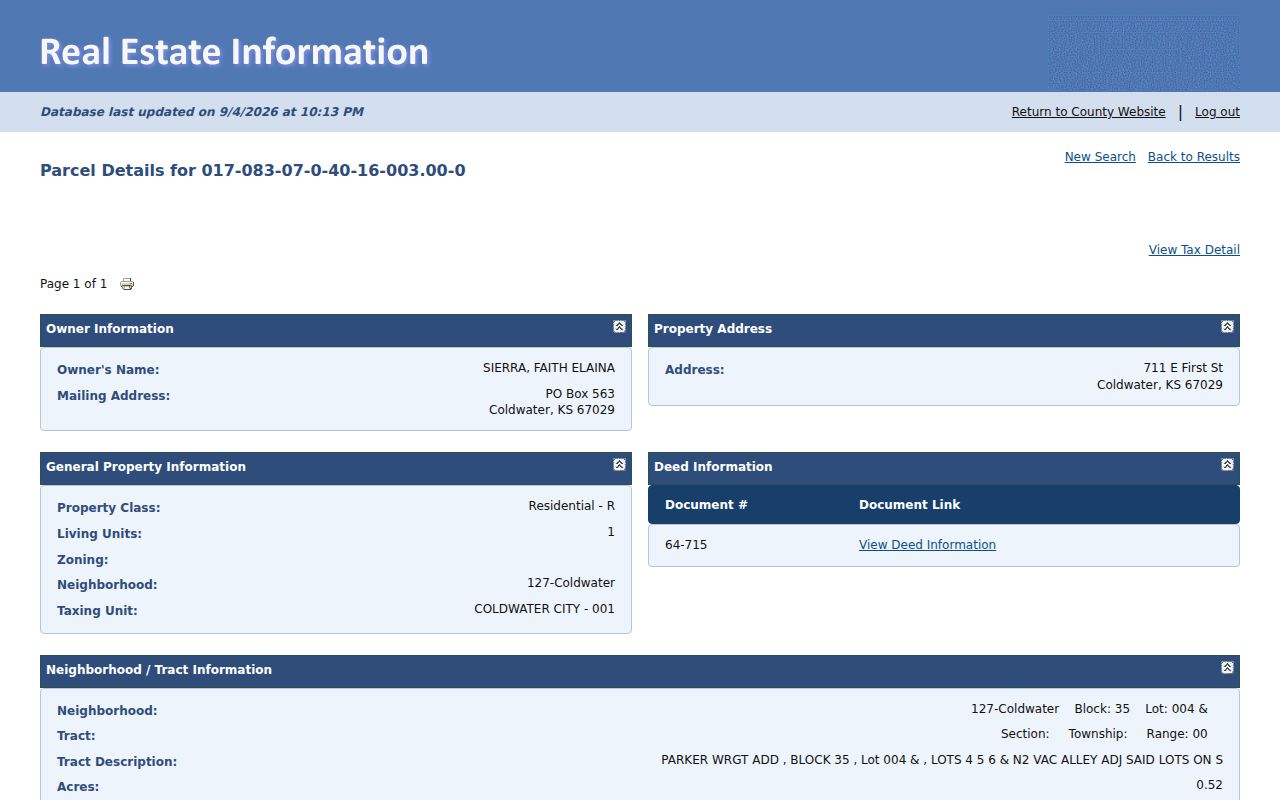
The official parcel card makes the key point plain. A current owner name is credible only when tied to the right PID and legal description.
The same card also warns against overreading. Its deed link shows a document number only. No deed image, consideration amount, or last-sale field appears. The value history describes appraisal work, not a price anyone actually paid. Building traits likewise describe the assessment record. They say nothing about current occupancy or condition. Copy these fields when they help identify the parcel. Just do not treat them as proof of who lives there or when title last changed.
A second Coldwater sample pairs a Protection mailing address with a Coldwater situs. A vacant-lot sample instead carries a rural Road 5 mailing address. Same rule every time. Verify the current owner against the land's PID and legal description. Never pick an owner because a mailing city or a surname seems to fit.
Check Comanche County Record Dates
Three dates answer three different questions. A card's update time says when that page was refreshed. The valuation year marks the tax value period. The recorder's filing date records when an instrument entered the Comanche County land record. None substitutes for another. CIC cards show updates on June 26, July 28, August 28, and September 2 in 2026, a pattern of active maintenance rather than a promised daily schedule. No county source states an average closing-to-roll delay.
Recent sale check. The roll can lag a closing. The newest recorded deed is the more current evidence of a transfer.
The Appraiser's annual schedule adds context. It does not set the owner-update delay. Kansas valuation work uses a January 1 status date. Change-of-value notices tie to March 1. The Comanche County roll is certified by June 1. Those dates govern assessment administration, not the day a fresh deed changes the indexed owner name.
Distinguish Current Owner Addresses
A mailing address is a contact clue. One card lists a Protection mailing address while the situs sits at 302 E Maple Street in Coldwater, with the taxing unit staying Coldwater. Both fields matter. Any Comanche County property search should keep the situs, the mailing address, and the taxing unit in view. A PO box or outside city proves nothing about residence. Kansas Safe at Home participants may use substitute mailing information. Keep any contact lawful and tied to a real property matter.
The taxing unit offers another check. Coldwater cards show COLDWATER CITY-001. Protection examples show PROTECTION CITY-002. These are routing and tax-roll fields, not title language. Compare them with the situs and the ORKA city-limit layer when a parcel sits near a city edge. Postal ZIP geography alone cannot settle municipal jurisdiction.
Verify Comanche County Entity Owners
An owner label can name a trust, an estate, a company, a trustee, or a public body. CIC offers no classification that sorts those roles. Copy the label exactly. Then inspect the deed. Search the business name through the Kansas Secretary of State when that helps.
The state's business result confirms an entity name, Kansas ID, status, and resident agent. That agent is not the owner. A trust or estate calls for the recorded instrument. A probate file may matter too.
The City of Protection card is a fine example. It names the city as the Comanche County roll owner at 304 N Lincoln Avenue, tied to a PID, an original-town legal description, and document 64-726. A public body fills the same Owner's Name field as any person. The deed is still required. It shows the interest actually conveyed.
Use Comanche County Office Access
If CIC does not answer your question, call the Appraiser at 620-582-2544 or visit 201 S New York in Coldwater, open 8 to noon and 1 to 5. The Register of Deeds answers 620-582-2152 and closes for lunch from noon to 1. Have the street address, full PID, legal description, and the owner's exact spelling ready.
A written KORA request can ask for non-exempt records by parcel, date range, and format. Kansas agencies must generally respond as soon as possible, and no later than the end of the third business day. The office does not have to create a new answer where no record exists.
Whether by phone or at the counter, keep an owner inquiry separate from a title opinion. Ask the Appraiser to walk you through the roll fields on display and the update timestamp. Ask the recorder for the most recent instrument affecting the full legal description, not just a deed tied to a similar street address. If you also need a tax balance, call the Treasurer at 620-582-2964; the county publishes no public tax-bill search link.
Bring document references when the card lists them. Known examples include 64-715, 64-718, 64-720, 64-726, and 64-717. Request the grantee, grantor, recording date, instrument type, and any later filing tied to the same land. The county offers no official online deed index and states no coverage cutoff, so a direct recorder search stays essential.
Keep a short audit trail. Save the card URL, access date, update time, owner spelling, mailing and situs fields, PID, legal description, and the recorder's response. If the two offices disagree, record both dates and ask when each office posted its record. That way you report what each source says now, without claiming more certainty than the records support.
Use Current Owner Data Lawfully
The roll's mailing field is a public contact route. It reveals no occupant, permits no intrusion, and settles no title. For the broader address-to-owner method, see the Comanche County property owner route.
Lawful use. Contact a current owner only for a legitimate property purpose. Never use public owner information to stalk, harass, or harm anyone.